


Overhead Transmission Towers
Q235 and O345 grades, welded base parts, bolted sections, and conditional climbing pegs define the available construction.
Overhead Transmission Towers carry conductors and ground wires above a power corridor while maintaining separation from the terrain and nearby buildings. The structural frame uses single equal angle steel or combined angle steel in the specified Q235 and O345 grade groups. Connection plates and coarse bolts join the sectional lattice members, while several steel plates may be welded together to form a combined tower-foot component. The sectional arrangement is convenient for transport and erection. When the height is below 60m, climbing pegs may be installed on one principal member. The tower configuration can then be matched to the required overhead route position without mixing material grade, base fabrication, and access details.
Components
|
Part |
Function |
|
Angle-steel members |
Single equal angles or combined angles forming the lattice framework. |
|
Connection plates |
Steel plates joining structural members at the nodes. |
|
Coarse bolts |
Fasteners carrying shear across the bolted sections. |
|
Welded base plates |
Several steel plates combined into the tower-foot component. |
|
Climbing pegs |
Access fittings arranged on one principal member below 60m. |
Main Applications
• Overhead power routes where conductors must remain supported above terrain and nearby buildings.
• Straight, tension, corner, terminal, transposition, and crossing positions along the line route.
• Lattice structures using Q235 or O345 angle-steel members and galvanized surfaces.
• Sectional tower packages that use bolted framework members for transport and erection.
• Structures below 60m where a principal member may include climbing pegs for access.
Our Factory
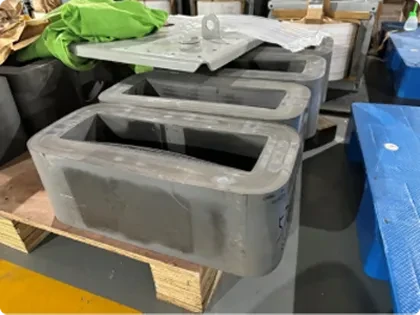
Heavy plate and welded-section work is supported by a 15000×6000 CNC plasma cutter, gantry submerged-arc welding equipment, longitudinal-seam welding machinery, hydraulic closing and straightening units, and a W11S25×2500 plate roll. Ten-ton bridge and gantry cranes assist workshop movement. These facilities provide a distinct production route for plates, welded base parts, and larger steel sections.
FAQ
Q: Which steel grades are available for Overhead Transmission Towers?
A: The structural members use the specified Q235 and O345 grade groups for project-specific member selection and fabrication planning.
Q: How is the Overhead Transmission Towers foot constructed?
A: Several steel plates may be welded together to form a combined base component beneath the sectional lattice.
Q: When can climbing pegs be included?
A: They may be placed on one principal member when the tower height is below 60m, keeping the conditional access provision separate from grade, base fabrication, and route position. The access entry remains conditional rather than automatic.
Hot Tags: overhead transmission towers, China overhead transmission towers manufacturers, suppliers, factory, 220 kv tower, 400 kv tower, best rated power tower, high tension tower, large power line towers, powerhouse power tower
You Might Also Like


Send Inquiry