


How does the shape of the tallest monopole tower affect its stability?
Jan 15, 2026
Leave a message
In the realm of modern infrastructure, monopole towers stand as remarkable feats of engineering, serving a multitude of crucial functions. As a prominent supplier of Tallest Monopole Tower, I have witnessed firsthand the intricate relationship between the shape of these structures and their stability. In this blog, we will embark on a scientific exploration to understand how the shape of the tallest monopole tower affects its stability.
The Basics of Monopole Towers
Monopole towers are single - column structures commonly used for various applications, including telecommunications, power transmission, and lighting. Their design is favored for its simplicity, space - efficiency, and aesthetic appeal. Monopole Electric Tower and Tower Steel Pole are two common types within the monopole tower family.
The stability of a monopole tower is of utmost importance. A stable tower can withstand various external forces such as wind, seismic activity, and the weight of equipment mounted on it. Any compromise in stability can lead to catastrophic failures, endangering lives and disrupting essential services.
Geometric Shapes and Their Impact on Stability
Tapered Shape
One of the most common shapes for monopole towers is the tapered shape. A tapered monopole tower is wider at the base and gradually narrows towards the top. This shape offers several stability benefits.
From a structural engineering perspective, the wider base provides a larger foundation area. According to the principles of statics, a larger base area distributes the tower's weight and the external loads more evenly over the ground. This reduces the pressure exerted on the soil, minimizing the risk of settlement or tilting. For example, in areas with soft soil, a tapered tower can better resist the tendency to sink compared to a non - tapered one.
The tapering also affects the tower's resistance to wind forces. Wind exerts a lateral force on the tower, and the shape of the tower determines how this force is distributed along its height. A tapered tower presents a smaller cross - sectional area to the wind at the top, where the wind speed is generally higher. This reduces the overall wind load on the tower. The tapering also helps to create a more streamlined shape, reducing the drag coefficient. A lower drag coefficient means that the tower experiences less wind - induced stress, enhancing its stability.
Straight - Walled Shape
In contrast, a straight - walled monopole tower has a constant cross - sectional area along its height. While this shape may be simpler to manufacture, it has some drawbacks in terms of stability.
The uniform cross - section means that the wind load is distributed more evenly along the height of the tower. At higher wind speeds, this can result in higher bending moments, especially at the base of the tower. The base of a straight - walled tower has to bear a significant amount of stress, which can lead to fatigue and potential failure over time. Additionally, without the tapering effect, the straight - walled tower may be more prone to vortex shedding. Vortex shedding occurs when wind flows around a structure and creates alternating vortices on either side, causing the tower to vibrate. These vibrations can further weaken the tower's structure and compromise its stability.
Multi - Segmented Shape
Some monopole towers are designed with a multi - segmented shape. These towers are composed of several sections with different diameters or shapes. This design approach allows for a more customized response to different external forces.
For instance, a multi - segmented tower can have a wider and stronger section at the base to handle the majority of the weight and the lower - level wind forces. The upper sections can be designed to be more aerodynamic, reducing the wind load at higher altitudes. This combination of different segments can optimize the tower's stability while also considering factors such as manufacturing and transportation constraints.
Material and Shape Interaction
The choice of material for a monopole tower also interacts with its shape to affect stability. Most monopole towers are made of steel due to its high strength - to - weight ratio.
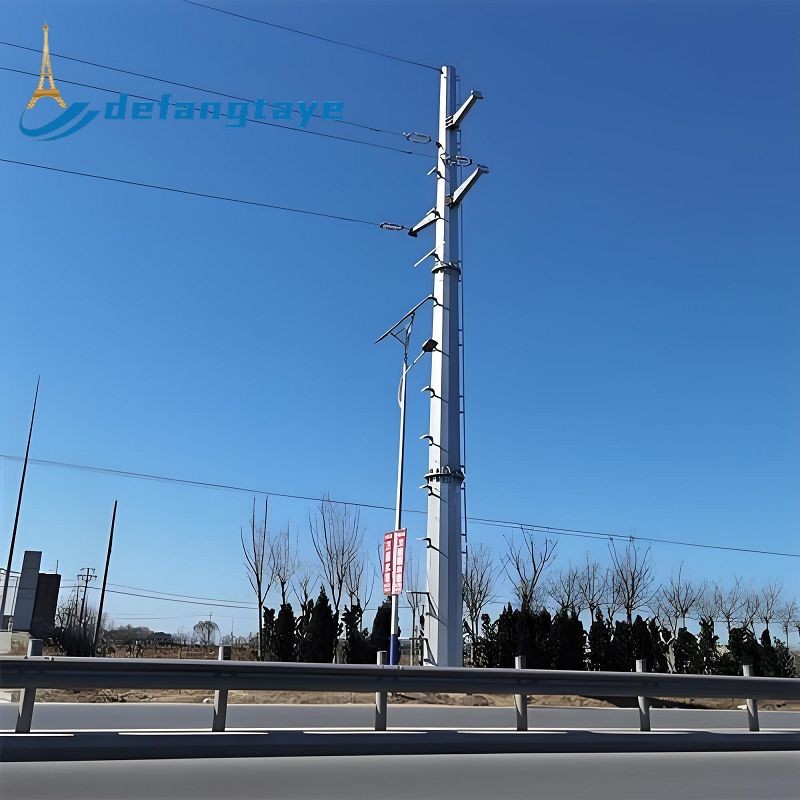

The shape of the tower influences how the steel material is stressed. In a tapered tower, the stress distribution is more favorable. The steel at the base, where the loads are highest, is in a more compressive state, which is a natural strength of steel. The tapering also allows for a more efficient use of the steel material, as less material is needed at the top where the loads are lower.
On the other hand, in a straight - walled tower, the steel has to resist higher bending stresses, especially at the base. This may require a thicker wall of steel to ensure stability, which increases the weight and cost of the tower.
Environmental Factors and Shape Adaptation
Wind - Prone Areas
In areas with high wind speeds, the shape of the monopole tower needs to be carefully designed to enhance stability. A tower with a streamlined and tapered shape is often the preferred choice. Additionally, some towers in windy regions may have additional aerodynamic features such as helical strakes. These strakes are small, spiral - shaped protrusions on the tower's surface that disrupt the formation of vortices, reducing the vibration caused by wind.
Seismic Zones
In seismic zones, the shape of the tower should be designed to withstand ground shaking. A tapered tower can be more effective in dissipating seismic energy. The wider base provides a more stable foundation, and the tapering helps to reduce the inertia of the upper part of the tower. This reduces the forces transmitted to the base during an earthquake, minimizing the risk of collapse.
Importance of Shape in Tallest Monopole Towers
As the height of a monopole tower increases, the challenges to stability become more significant. The tallest monopole towers are subject to stronger wind forces at higher altitudes and more complex dynamic behavior.
The shape of the tallest monopole tower plays a crucial role in its ability to withstand these challenges. A well - designed shape can ensure that the tower remains stable under extreme conditions. For example, the tapered shape can counteract the increased wind load and the higher bending moments associated with greater height.
Conclusion and Call to Action
In conclusion, the shape of the tallest monopole tower has a profound impact on its stability. Whether it is the tapered shape, straight - walled shape, or multi - segmented shape, each geometric design has its own advantages and disadvantages in terms of stability. Understanding these relationships is essential for designing and constructing safe and reliable monopole towers.
As a leading supplier of Tallest Monopole Tower, we are committed to providing high - quality towers that are designed with stability in mind. Our team of experienced engineers uses the latest scientific knowledge and advanced design tools to optimize the shape of our towers for different environmental conditions.
If you are in need of a monopole tower for your project, we invite you to contact us for a detailed discussion. Our experts can help you choose the right shape and design to ensure the stability and performance of your tower.
References
- "Structural Engineering Handbook" by Arthur H. Nilson and David Darwin
- "Wind Effects on Structures: Fundamentals and Applications to Design" by Alan G. Davenport
- "Seismic Design of Buildings and Bridges" by Jack Moehle
Send Inquiry